

5 Ways to Start the New Year Feeling Like That Woman

There are usually two perspectives on how to approach the new year. Some women enjoy setting goals and intentions for the year ahead. Other women prefer not to create any major goals outside of their usual goals. Both types of personalities could benefit by reflecting and redefining what you do want in your life. Take a look and see what could help you!

1. Re-asses Your Life

Take the New Year as an opportunity to re-assess how the year has gone so that you can become more clear and intentional actionable steps.

Here are questions to ask yourself:

Where did I do well?

Where did I fall short?

What could I do better on moving forward?

What was an unexpected challenge?

In what ways did I experience growth?

2. Clearly Define What You Intend To Achieve

After some reflection and defining what you intend to accomplish. You reverse engineer how to determine what is the first small step you need to take.

Example:   Intention- Be an early riser and focus on healthy habits.

 First Step: Set the alarm

 Second Step: Drink lemon water while you journal.

Third Step: Exercise

 Now your day starts as usual, shower, get ready etc.

3. Learn to Slow Down Before You Speed Up

This one can be challenging because it may seem counterintuitive. When you are trying to accomplish the most, why would you slow down? Let me explain.

When trying to accomplish something or you have a lot to do, you may feel the need to rush and or stress on what needs to be done. Usually, when stress is triggered, you may become more emotionally distressed, which directly impacts what you are doing. You may become forgetful, make more mistakes, lose something, etc.

It’s best to slow down, whether it be for minutes or hours take an inventory of what is needed to execute something to the best of your ability. Then break down into smaller doable tasks. Now you ramp up to work quickly, but efficiently.

4. Find Support and Delegate

It is vital when assessing your situation or what you intend to do to see where you need support. Seeking support can accelerate your progress toward your goals instead of doing it alone. This is also an opportunity to delegate and hand off what is best done by others.

For example, if building a website takes an absorbent amount of time and time is best used creating, then this would be a perfect opportunity to delegate or find support to move through areas of struggle quickly.

5. Identify Where Time Is Spent

In today’s life there is so much distraction that most of us, if not all of us are impacted. It is easy to check work e-mail and stumble upon Instagram and TikTok. The ease of distraction is in our hands and in our faces all day. I often hear, “I don’t even realize how long I was scrolling for.” Avoidance and distraction are easy to feed with technology.

The best way to combat this distraction, which ultimately impacts your concentration and productivity, is to set limits. Setting limits look different for everyone, but if you know where excessive time is lost then that is where you want to set a limit.

This limit could be you setting a manual time on your phone or Alexa, and once it goes off, you know you are done. There are apps such as Opal that help you set limits. iPhones have time limits as well that remind you. Time is up. For others, they may need to remove apps altogether and only access them on purpose on a computer.

Distraction and avoidance come in many forms such a tv, shopping, going out, etc. This is an area that needs regular maintenance and reassessment.

Becoming the woman you want to be is an ongoing journey. I often say I will always be a lifelong learner because there is always room for growth. Different seasons of life require different aspects of us. What may be your focus and intention this year may be completely different the next year. This is what growth requires of us. There is value and peace in having clarity with what you hope to do and what you intend to accomplish.

Inner Peace Starts Here: Creating Mental Boundaries That Stick

Everyone is talking about setting boundaries. There are so many perspectives about how to apply, strengthen, or soften them. What I hear less often is about the boundaries within our minds. The mind is said to have thousands of thoughts per day; this means your mind and thoughts are constantly going and most often unchecked. Most people have varying degrees of self-criticism, negative self-talk, unhealthy beliefs, etc. The list is endless here. Literally, you can think of anything, real or imagined. However, we hear concepts about managing thoughts by practicing Cognitive Behavioral Therapy or just therapy in general. We all have thoughts we would rather not have or spend time thinking about. So, what do we do about it?

Skills to set your own mental boundaries

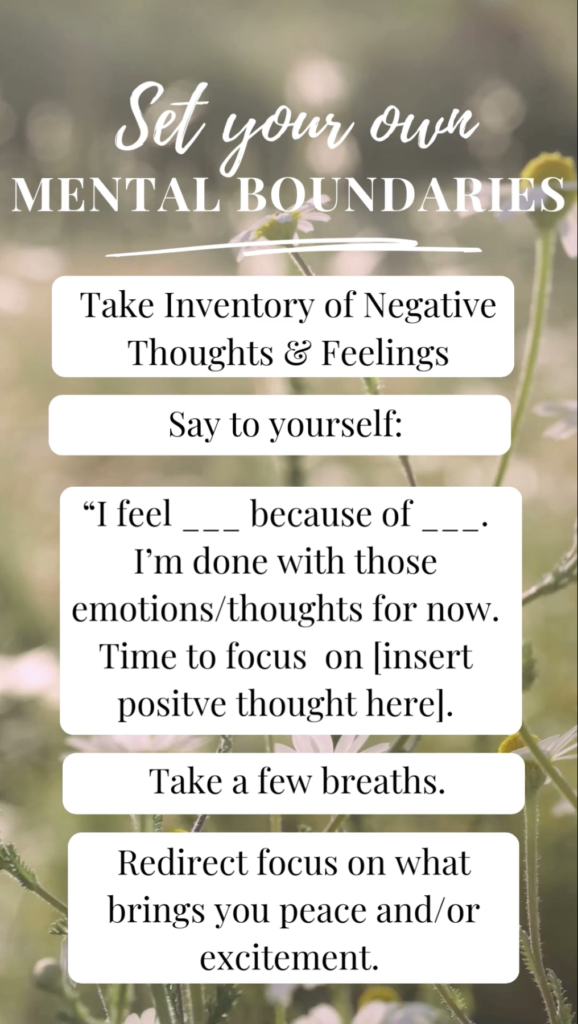
This means you take inventory of thoughts and emotions. Identify what brings you joy and what makes you feel the opposite. Usually, the not-so-good emotions are the ones you will need to set limits for. You begin to do this consciously, recognizing you have started to feel bad, angry, sad, etc. For one second or a minute at most, review the thoughts or beliefs. Acknowledge I feel X because of X. Say to yourself now I’m done with those feelings for now. Now to focus on [insert happier more positive thoughts].

Easier said than done, is what I hear most often. Truth is, it’ll feel hard and ineffective at times, depending on how strongly you feel. The trick is repetition and consistency. Once you have created a habit of doing this it will become easier and eventually automatic.

This does not mean you just ignore everything; this simply means, for the purpose of my day, I will not become consumed or taken down by these negative thoughts/beliefs. I always encourage to allow time to process the day by journaling, talking to ourselves, or allowing for emotions to come up when it feels safe to do so. For example, you can do these things if you have time in the morning and then add some minutes to your routine. Sometimes its easier at the end of the day after you have winded down and can have some time alone with your thoughts. You decide when is best for you.

Here is an example, if I’m stressing about a work presentation and it keeps popping up in my mind. I think of all the things that could go wrong, what my boss will think, will I start stuttering, what if I forget, etc. There is absolutely no need for me to think about any of these things for more than a few seconds. It’s miserable, emotionally draining, and unproductive. The best thing is to recognize what direction I am going in and notice it and choose a completely different area of focus or be proactive and spend more time preparing and practicing to increase confidence and trust that I will do great because I’m prepared.

We have choices about how we choose to think and where we put our attention.  Imagine you’ve been driving on one road, and you’ve reached a fork in the road. The road you have always traveled may be the path you frequently take where you often lose your patience. You could continue to keep going the way you have always gone or consider the new road that leads to the desired destination, offering a potentially easier path. This is where you might say, “I usually lose my temper when I’ve lost my patience. The new road gives me a 10-minute delay that allows me to calm down and I don’t end up blowing up.” You will feel better because you did not have to lose your temper. Remember, you always have a choice about how you will react or feel. The new path is another opportunity to experience something differently and determine if it’s right for you. Practice is everything. We are human, and by nature, we are designed to have intense emotions, but we don’t have to let our difficult emotions get the best of us. Intense emotions can be moved through quickly.

The path to peace is often encountered when we can effectively manage our mood, thoughts, and reactions. The mental and emotional boundaries we set can lead us to more moments of peace, happiness, and more of what we do want in our lives. Boundaries within ourselves is part of the path of self-mastery and truly healing.

What is Quantum Hypnosis

Let’s start off with what it’s not. Quantum Hypnosis is not what you once may have seen at the fair where people from the audience are asked to go on stage and do silly dances. This type of hypnosis is not suggestive and does not implant what you should think or do. The first program I was trained in was by Dolores Cannon, who created the Quantum Healing Hypnosis Technique (QHHT). Since then, I have trained to be a Beyond Quantum Healing (BQH) Practitioner, which was created by Candance Craw-Goldman. They are different styles of quantum hypnosis but are similar with their intent to help people heal. The purpose is indeed to help people find peace and healing by learning through yourself.

Quantum Hypnosis is relaxation with a purpose that allows your subconscious to reveal itself. Most often, the subconscious is trying to reveal something to you.  

With this method of hypnosis, the practitioner is not leading you to come up with a story. As practitioners, we simply ask you to share what you are feeling, seeing, hearing, and experiencing. Your mind will create an image or feelings, and we ask questions to help you understand what you are experiencing. Essentially, you are helping paint the picture for us to walk this journey with you and help you explore what your subconscious has brought up. We help you help yourself on your healing journey.

There are three parts to Quantum Hypnosis:

Interview: This is the first part of the session. Here, the Practitioner discovers the reasons behind the individual’s participation in a hypnosis session. The interview is also a short review about your life, relationships, goals, etc. This process is usually 1.5-2 hours long.

Past Lives, Guides, and Memories:

The last two hours of the visit are under hypnosis, where the subconscious will bring up what it wants you to see. This can range from early memories that may need revisiting to a past life. In a past life, it’s you in a different body and in a different environment. Usually, there is something for you to see and experience. The practitioner aims to help you understand why you are having this experience. For some it may be a visit from a loved one or guides of some sort.

Subconscious:

If possible we access the deepest part of your subconscious. We can ask direct questions to the part of you that holds all the answers, which is what Dolores Cannon called the higher Self, the Over-Soul, or the Super Conscious. This is where questions that you are seeking answers to can be answered. Questions can range from why I have leg pain to why I attract certain kinds of relationships. Questions can be about health, life struggles, finances, relationships, and pretty much anything about yourself and your experience in this life.

This is but a brief explanation of what Quantum Hypnosis does. The stories from sessions are absolutely incredible, profound, and life-changing. This is something I highly recommend people experience at least once in their lives if they are feeling called.  Please feel free to ask any questions if you are wondering if hypnosis is best for you!