Purposely Peaceful Core Values

A guide to living with purpose, peace, and authenticity. 

Here are but a few examples. What are your top 3?

1. Inner Peace First – Prioritizing mental, emotional, and spiritual calm in all aspects of life. 

2. Authenticity – Embracing your true self without fear of judgment. 

3. Empowerment – Providing tools, guidance, and support to help individuals reclaim personal power. 

4. Compassion – Leading with kindness for yourself and others, even in challenging moments. 

5. Growth & Transformation – Committing to continuous self-improvement and deep inner work. 

6. Connection – Fostering meaningful relationships with family, community, and self. 

7. Courage – Facing fear, discomfort, and change with resilience. 

8. Mind-Body-Spirit Alignment – Honoring the connection between physical, emotional, and spiritual health. 

9. Mindful Living – Practicing presence, intention, and gratitude in daily life. 

10. Integrity – Acting in alignment with your values, purpose, and highest self. 

11. Joy & Celebration – Embracing life’s moments with gratitude and playfulness. 

12. Healing – Prioritizing emotional, mental, and energetic restoration for oneself and others. 

13. Respect – Honoring the dignity, perspectives, and boundaries of yourself and others. 

14. Honesty – Committing to truthfulness in thought, word, and action. 

15. Responsibility – Taking ownership of your actions, choices, and their consequences. 

16. Fairness – Treating everyone with equity and justice. 

17. Gratitude – Cultivating appreciation for life, experiences, and people. 

18. Patience – Practicing tolerance and understanding in challenging situations. 

19. Generosity – Sharing time, energy, and resources with openness and care. 

20. Resilience – Bouncing back from setbacks with strength and adaptability. 

21. Curiosity – Staying open to learning, exploring, and understanding. 

22. Love & Kindness – Leading with warmth, empathy, and compassion in all interactions. 

23. Adventure – Seeking new experiences, exploration, and stepping outside comfort zones. 

24. Creativity – Expressing ideas, imagination, and innovation in life and work. 

25. Freedom – Honoring autonomy, choice, and self-expression. 

26. Playfulness – Allowing joy, fun, and light-heartedness into daily life. 

27. Openness – Remaining receptive to new perspectives, ideas, and growth opportunities. 

28. Balance – Cultivating harmony between work, rest, play, and relationships. 

29. Inspiration – Motivating oneself and others to pursue purpose and passion. 

30. Wonder – Embracing awe, curiosity, and appreciation for life’s mysteries.

What to Do About Depression: Steps to Reclaim Your Inner Peace

Feeling depressed or stuck can be heavy and confusing, but it doesn’t have to stay that way. If you recognize yourself in the stages of depression, there are actionable steps you can take to start moving toward hope, healing, and inner peace.

Here are some ideas to help you get out of that funk and back to living the life you want. 

Of course, we won’t be there overnight, but trust that if you put one foot in front of the other, you’ll eventually get to where you want to be. 

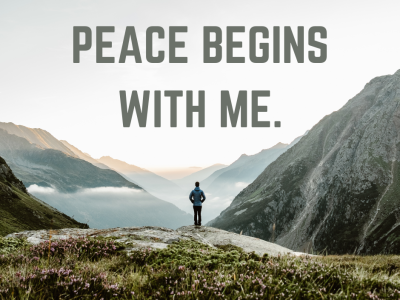
Peace begins with me. Hope. Inpsiration.

1. Own Where You’re Really At

Admitting the truth about your life is the first step. Maybe you dislike your job, your working conditions, or even a relationship you’re in. Perhaps you need to take responsibility for the choices you’ve made. This part can feel brutal, but seeing what’s keeping you low is essential to making change.

2. Process Your Emotions

Avoiding feelings only makes the cloud above you heavier. Start paying attention to what’s happening inside. Episodes like Feel to Heal can guide you through what it looks like to process emotions effectively. Give yourself permission to feel anger, sadness, or frustration without judgment—these are signals pointing you toward change.

3. Seek Guidance and Support

You don’t have to do this alone. Therapy, hypnosis, or other personalized support can help you see your patterns, break habits, and identify what’s keeping you stuck. Even one meaningful session or conversation can be the spark that reignites your inner motivation.

4. Replace Negative Beliefs with Positive Dialogue

When I was depressed in my early 20s, I played The Secret on repeat to replace the negative voice in my head with hopeful dialogue. Today, we have endless ways to do this—through podcasts, audiobooks, and supportive communities. Surround yourself with messages that uplift and inspire you.

5. Take Inspired Action

Small steps matter. Create vision boards, spend time with supportive people, set boundaries, and show up consistently for yourself. Avoidance and bad habits only prolong the funk. Taking deliberate action—no matter how small—helps reclaim your energy and personal power.

6. Focus on Inner Peace

Your mental, emotional, and physical well-being is your most valuable asset. True contentment doesn’t come from houses, degrees, or possessions—it comes from cultivating inner peace. Make your peace a priority, and use it as the foundation for the life you want to live.

7. Remember Your Worth

You are inherently worthy simply because you exist. You don’t need to prove anything to anyone. Investing in yourself and prioritizing your well-being is never selfish—it’s necessary. The positive ripple effect of your healing impacts everyone around you.


Crisis Resources

If you feel overwhelmed, hopeless, or unsafe, you are not alone. Help is available:

  • 988 – Suicide & Crisis Lifeline (U.S.): Call or text 988 for immediate support, available 24/7.

  • If outside the U.S., search for your local mental health helpline for immediate assistance.


Depression is real, but it’s not forever. By taking ownership, processing emotions, seeking support, and prioritizing your inner peace, you can move from heavy and stuck to hopeful, empowered, and alive again.

The Epidemic of Depression: Understanding the 7 Stages

Have you ever unexpectedly found yourself feeling unhappy, frustrated, or lacking motivation? You’re not alone. Depression isn’t exclusive to any particular type of person—it can creep up on anyone, whether you’re rich or poor, successful or “living an easy life.” I call this the epidemic of depression, and it’s something I’ve experienced myself, seen in loved ones, and witnessed throughout my career as a therapist.

Depression can feel like a heavy, dark cloud that blurs the light of hope and makes life feel exhausting. It seeps into every area of life if left unprocessed, leaving you drained, unmotivated, and unsure of how to move forward.

Here’s why depression shows up, and the 7 stages I’ve seen in my life and with clients:

7 stages of depression and hope

Stage 1: Ignoring Your Truth

Depression often begins when we stop moving in the direction of our highest potential. We ignore what truly matters to us and chase goals or expectations that don’t align with our inner truth. For me, it was believing that achieving certain milestones—like degrees or career success—would automatically bring happiness. Instead, suppression of what I really wanted only created more heaviness.

Stage 2: Missing the Early Warning Signs

Before the cloud grows heavy, there are clues. Increased sugar cravings, avoidance, restlessness, irritability, or other coping behaviors are early signals that something isn’t right. Recognizing these signs early can make a huge difference.

Stage 3: Feeling the Weight of Life’s Responsibilities

Life’s pressures can feel like concrete boulders on your shoulders. Work, relationships, and obligations drain your mental and physical energy, making it harder to see a way out.

Stage 4: Your Ego Works Against You

Negative thoughts and assumptions start to dominate your mind. The ego sets up patterns that drain emotional energy, leaving you depleted and less able to cope.

Stage 5: Shutting Down Hope

As hopelessness sets in, big dreams and belief in infinite possibility begin to fade. Motivation wanes, and even the drive to do daily tasks feels like a struggle.

Stage 6: Feeling Heavy and Confused

By now, depression feels thick, confusing, and overwhelming. You may not know where to start or how to feel better. This is often the stage people describe as “the worst of it.” It’s okay to get help. Click here to read more about what you can do and find some resources.

Stage 7: The Spark of Good Anger

Eventually, most people reach a point where they can’t stay down and out forever. Good anger arises—a burst of energy that allows you to reclaim your personal power, set boundaries, and take action to shift your life. You realize, “It ends today.”

Depression isn’t permanent. You can be content, peaceful, and joyful again—but it requires awareness, inner work, and support. Recognizing where you are in these stages is the first step.

The key is to start reclaiming your inner peace: pay attention to your truth, process your emotions, seek guidance if needed, and take small consistent steps toward the life you know you deserve. Even if you’re in the early stages, it’s never too late to pull yourself out.

Remember: your mental, emotional, and physical well-being is your most valuable asset. You don’t have to follow society’s rules of success. You can pave your own way, live intentionally, and create a life that begins with inner peace.

Read this post to get a new perspective and practical ways to rise above it, plus resources for support. Click Here

This post is for informational purposes only. This is only my perspective & I hope it helps!

Core Beliefs Are Quietly Running the Show (And What You Can Do About It)

Let’s talk about something that’s silently—but powerfully—shaping your life:
Core beliefs.

These deeply rooted thoughts are running in the background, influencing how you think, feel, respond, and make decisions… and most of the time, we don’t even realize they’re there.

But here’s the truth:
If you’re someone seeking real, lasting inner peace, understanding your core beliefs isn’t just helpful—it’s essential.


What Are Core Beliefs, Really?

Core beliefs are the ideas we hold about ourselves, others, and the world. They shape how we interpret everything—from a stranger’s comment to the way we talk to ourselves in the mirror.

These beliefs are like a lens we see the world through. They’re subtle but strong. They’re constantly coloring our expectations, reactions, and sense of identity.

And most of them? We didn’t choose consciously.


So, Where Do They Come From?

Core beliefs often begin in childhood. We absorb them from the environment around us—without anyone needing to say a word.

Think about your parents or caregivers. Were they critical? Fearful? Confident? Anxious? Loving?
You likely absorbed some of that energy, even if it wasn’t ever talked about.

For example, my mom and some of my aunts were always a little anxious. I have so many memories of them squealing or getting startled by simple things. It was like they were constantly on edge, ready to be scared. As a kid, I didn’t realize it, but I was already picking up on beliefs about fear, safety, and unpredictability.

Then we go to school, and the conditioning continues.
We learn what gets rewarded. We learn what gets us in trouble.
Shame becomes a teacher.
By middle school, we’re dressing alike, thinking alike, and shrinking ourselves to fit in. I have so many memories of doing that—shrinking for comfort, but also to make other people more comfortable.

It was in those small moments that I started becoming more self-aware… but I didn’t yet understand what I was actually carrying.


Our Minds Are Programmable (Even If That Sounds Weird)

When I was learning Quantum Healing Hypnosis Technique (QHHT), Dolores Cannon said something that really stuck with me:
Watching TV is the first stage of hypnosis.

That blew my mind—but it makes sense.

Think about it. We’ve seen ketchup, toilet paper, and soda commercials our entire lives. So when I say “ketchup,” a brand probably popped into your head without even trying.

That’s the power of suggestion.
That’s programming.

So if I walk into a store and see 50 different kinds of ketchup, I’m most likely going to reach for the one my subconscious already associates with safety or familiarity. But now, I look at ingredients. I’ve become more intentional. And that’s the point—what you’re exposed to matters.
Your brain is always absorbing, and it’s been that way since birth.


The Subconscious is a Recording Machine

Hypnosis has shown me just how powerful the subconscious really is.
I’ve witnessed people recall vivid, detailed memories—not just from this life, but from past lives—with so much clarity it’s like they’re reading from a script.

Science says we only use about 5% of our conscious mind. The other 95%? That’s the subconscious.
To me, that means your mind is capable of recording every single moment of your life.

And here’s something else I’ve learned:
The subconscious wants you to heal.

That’s why you have triggers.
That’s why life pulls you out of autopilot with unexpected challenges.
It’s not punishment—it’s an invitation.


A Personal Story: When a Belief Was Born

Let me give you an example of how core beliefs get created.

In 10th grade, I moved to a new city and started at a new school. A few months in, a girl I had become friends with said,
“When I first met you, I didn’t like you. You seemed stuck up. But now that I know you, you’re actually really cool.”

At the time, I laughed it off. But something in me held onto it.
I had heard similar things before… and a new doubt crept in:
“If people keep thinking that about me, maybe they’re right.”

That belief—that I must come off as unlikable—followed me into adulthood.
It made me second-guess first impressions.
I’d assume people didn’t like me, even if there was no real reason to believe that. I’d either overcompensate to prove I was likable… or shut down completely.

And even now, after years of inner work, that belief still shows up sometimes.
But the difference is: I have tools now.

Here’s what I remind myself:

  • I mean well.

  • I never intentionally try to be rude.

  • I’m allowed to feel peaceful without having to prove it.

  • How others perceive me is not my responsibility.

  • I sincerely wish people well.

That’s my truth.
So when old beliefs try to take the wheel, I come back to that.


Can More Than One Belief Exist at the Same Time?

Yes. And that’s what makes this so complex.

In that same situation, I also believed I’m kind, thoughtful, and want to connect with people.
So while part of me feared being disliked… another part of me just wanted to be real and connect.

Both were true.
The question is: Which one gets to lead?
My truth—or my fear?

That’s a personal choice.


Do Core Beliefs Come from Past Lives?

Yes—I believe they can.

Through hypnosis, I’ve seen again and again that not all core beliefs were formed in this lifetime. Some stretch back to past lives, ancestral trauma, or energetic imprints we’re still carrying.

I’ve worked with people who have intense feelings of low self-worth… but nothing in their current life explains it. Their childhood was supportive. Their relationships were fine. But those feelings were still there—like they were born with them.

Through hypnosis, we’ve uncovered that these beliefs began in lives long before this one.
And that awareness brings freedom.

Just because a thought or belief shows up… doesn’t mean it’s true.
Sometimes, it’s just a whisper from your past, asking to be healed.


How Core Beliefs Affect Our Daily Lives

Let’s take a common example: the people pleaser.

They say yes when they mean no.
They overextend themselves to avoid conflict or rejection.
They confuse love with sacrifice.

That’s a belief at work.
It might sound like: “I’m only valuable when I’m useful,” or “If I say no, they’ll leave.”

I see this all the time in my work.

But here’s the truth:
Loving yourself means understanding how you feel, and making decisions from that place.
And if you don’t know your beliefs…
You can’t reclaim your peace.


So, How Do We Start to Shift Core Beliefs?

Start here:
“What is the most loving thing I can believe—or do—in this moment?”

Let that question guide you.

Because your beliefs shape:

  • What you believe is possible

  • How fair or unfair life feels

  • Who’s right or wrong

  • And what kind of peace you allow yourself to experience

Beliefs aren’t inherently good or bad—they’re just powerful.
And if they’re misaligned with your truth, they will create tension.

The work is simple, but deep:
✨ Get curious
✨ Get honest
✨ Then get intentional


Final Thoughts

Core beliefs shape your identity, your peace, and your potential.
And when you become aware of them, you get to choose.

Does this belief support the life I’m creating? Or is it time to shift it?

Ask yourself these questions.
See what comes up.
And stay tuned for Part 2, where I’ll go deeper into how to identify and rewire your core beliefs—so they actually support your intention to live a Purposely Peaceful life.

If you ever want to see more of my day-to-day real life as I walk this journey of becoming purposely peaceful, follow me @jess_riverak.

And if you’re into podcasts, you can listen to Purposely Peaceful wherever you tune in. It’s honest, soulful, and straight from the heart:
Listen on Apple Podcasts
Listen on Spotify

Feel to Heal: The Emotional Work You Can’t Skip

Let’s talk about emotions — not the fluffy, surface-level kind that pop up and fade away. I mean the deep, lingering ones. The kind that stick around, press on your chest, or sneak into your thoughts at 2AM. The emotions you’ve been holding onto without even realizing it.

We all have them. And here’s the truth: you can’t heal what you won’t feel.

The Emotional Backpack We All Carry

Picture this — you’re walking through life with an invisible backpack. And every time you experience something painful, stressful, or overwhelming and don’t process it… it goes into the backpack.

A harsh word someone said? Pebble.

A betrayal that shattered your trust? Rock.

A trauma that changed you? Boulder.

Over time, this backpack gets heavier. And because we’re busy — working, parenting, caregiving, surviving — we rarely stop to unpack it. But our bodies feel the weight even when our minds are too distracted to notice.

Eventually, it catches up. Sometimes it looks like burnout. Sometimes it shows up as anxiety, panic, or chronic exhaustion. Other times, the body literally shuts down — because it’s been screaming for rest and release.

I’ve lived this. I’ve worked through this. And I’ve walked countless clients through the same realization: your emotions are trying to tell you something. Are you listening?

What We Were Never Taught

Most of us were never taught how to feel. We learned how to suppress. How to perform. How to keep going no matter what.

“Stop crying.”
“Suck it up.”
“Don’t be so sensitive.”

Sound familiar?

So, we learned to disconnect from our emotions instead of understanding them. But here’s the thing — emotions aren’t the enemy. They’re messengers. They’re trying to help you heal.

The Four-Part Cycle of Emotional Healing

If you’re ready to lighten your emotional load, start here:

1. Feel

Emotions are meant to be felt. That’s their job — to signal something inside us that needs attention. Whether it’s sadness, anger, fear, or even joy, allow yourself to feel it fully, without judgment.

2. Acknowledge

Bring awareness to what’s coming up. Name it. Is it grief? Is it shame? Is it resentment? When you name it, you reclaim some of your power over it.

3. Process

This is where healing happens. Journaling, therapy, meditation, or simply sitting in stillness — whatever helps you understand why that emotion exists and what it’s asking from you.

4. Release

Let go of what no longer serves you. Not by pretending it never happened, but by deciding you don’t need to carry it anymore. This might look like breathwork, crying, visualization, prayer, or even speaking it out loud.

Healing Is a Layered Journey

Sometimes you think you’ve healed something, and then — boom — it shows up again. That doesn’t mean you’re failing. It means you’re meeting that emotion at a deeper level. With new insight. With more strength.

Be patient with yourself. Some wounds heal in layers.

You Don’t Have to Carry It All

You don’t have to be the strong one all the time. You don’t have to pretend it doesn’t hurt. You don’t have to hold onto pain just because you’ve held it for so long.

You can feel it.

You can heal it.

And you can create a life that’s lighter, softer, and more peaceful — one emotion at a time.


💛 Want to explore this more deeply?
Listen to Episode 4: “Feel to Heal on the Purposely Peaceful Podcast for a heartfelt, guided look at emotional healing here.

If you’d like to stay connected or see a bit more of my day-to-day, you can find me on Instagram @jess_riverak. I share reflections, gentle reminders, and glimpses into real life as I walk this path too.


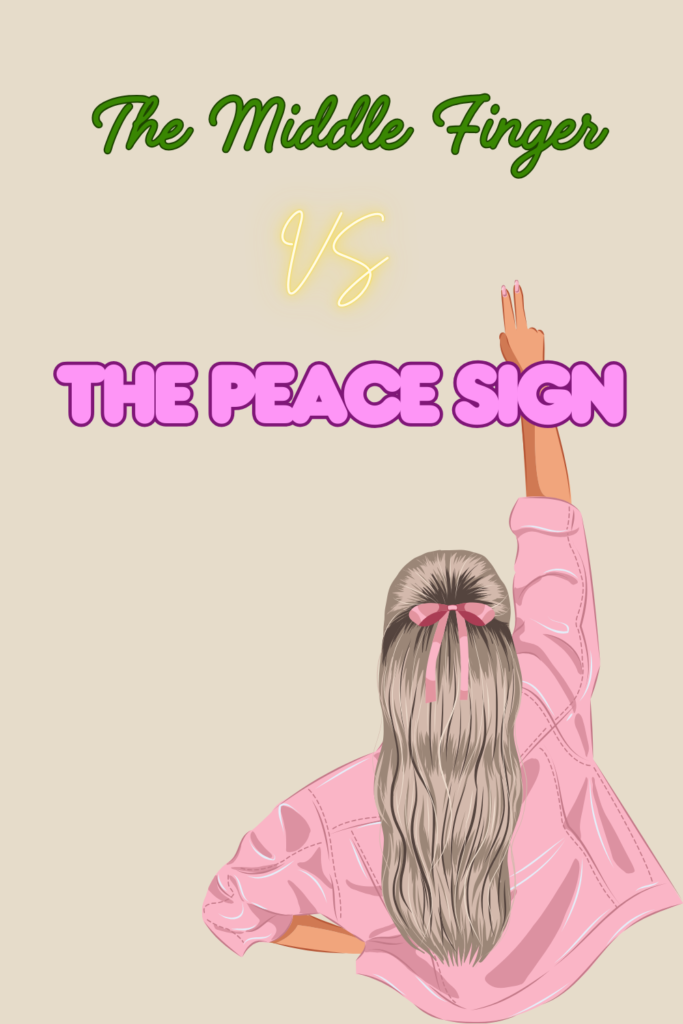
The Peace Sign vs. The Middle Finger: A Lesson in Personal Power

If you are ready to live the life you want, learning how to tap into your personal power is essential. We all have our own personal power, but most of the time, we unconsciously give it away or overexert it where it doesn’t belong. Let me begin by explaining what personal power is and what it isn’t.

What is Personal Power?

My definition of personal power is that it holds your infinite potential, energy, strength, confidence, and authentic highest potential. It’s knowing that you must take full responsibility for your life and own your decisions. Your personal power holds the ability to make conscious choices that are in alignment with your values, beliefs, and desires.

What it isn’t…

When we discuss personal power in this blog, we never refer to or consider the idea of overpowering, manipulating, or coercing someone else into doing what we want. We have no right to impose ourselves on others in this way; that would be a misuse of our personal power.

What do we do with our Personal Power?

If you’re anything like me, then you are going to want to tap into your personal power for the best potential outcome. Our personal power allows you to make conscious choices that align with healthy boundaries, your truth, and your intentions for an extraordinary life. Our personal power is the foundation for creating a life of peace, purpose, and fulfillment

Understand that we control how we think, feel, and act, and we have the power to shape our own destiny.

First and foremost, we need to identify how we are giving away our personal power.

 I’ll share a few of my own examples.

Years ago, I remember being met with upset drivers for a while. I’d be driving, minding my own business when, for no apparent reason, other drivers would become angry and flip me off. My reaction was always to give back to them what they gave me. So, if they showed me their middle finger, I would give it right back. I’d be upset because I felt that it was uncalled for. I’d become angry, and now my mood and my day were negatively impacted. I let these people get to me, essentially, I gave my power away because I let myself get angry.

One day, my husband was in the car with me, and he said, “Why don’t you just give them the peace sign?” When he said that, I was shaken to my core because I had never thought of it before. In that split second, I realized that it was a brilliant idea and that all this time, I had let other people influence my ability to express myself in a way that contradicted how I truly wanted to. I had been misusing my personal power.  

I’m a no-drama kind of person. Letting someone get to me didn’t resonate with who I felt I was. It was a much-needed ah-ha moment because I learned that I had the personal power to decide how I wanted to feel and how I wanted my day to go, and that it’s none of my business what that person was feeling. Instead of flipping someone off, I can just throw the peace sign. They don’t get to have any of my energy.

It’s like the saying goes, Not My Monkey, Not My Circus.

Remember, our personal power is best used when we are living in alignment with our highest values. Letting people or situations get the best of us is only giving away our personal power.

Imagine, being in a relationship with (or a working relationship) with someone who demands and demeans you and you just accept it. You don’t like how it feels, but because you don’t know how to approach it so you just take it. Or perhaps you have tried to approach this situation, but it backfires. Out of fear that it might get worse, you say nothing and put up with it. In many situations like this, it can feel as though you’re the victim. This is an example of letting someone take your power away.

But, if we look at this through the filter of your personal power, you are never a victim. In this scenario, you take responsibility for being in this dysfunction. And you would access your personal power to figure out how to exit this situation. This may look different for everyone, but it might mean you need to set boundaries, find a new job, or end a relationship. You are in control of your life.

How do we create the change?

    1. Recognize Your Power: Start by acknowledging that you can make choices that influence your life.
    2. Take Responsibility:  Take responsibility for the choices you have made that may have landed you in hot water. Let go of the victim mindset and own your decisions, even if they were influenced by the past experiences.
    3. Set Boundaries: Protect your energy by setting healthy boundaries and decide what kind of relationships you want in your life and what you no longer accept.
    4. Journal: Reflection and awareness will help you.
Here’s how I journal:

I begin with an update about my life or when I need to vent. I express my emotions, thoughts, beliefs, fears, and hopes on paper. I always try to find the silver lining in every situation- good or bad. And every few days or weeks go back and read your journal.

Can you see any patterns? What do you notice?

Your personal power allows you to make intentional, conscious choices toward cultivating the life you want. The path to peace is owning the fact that it’s up to you what will drain you, hurt you, inspire you, and motivate you. You hold the power and choose peace over chaos. You can choose peace over stress. You always have a choice.

Tapping into Inner Peace – Finding Stillness in the Chaos

It’s a term we hear often but may seem more like an idea than our reality. This idea of inner peace might conjure the image of monks sitting in a cave somewhere. Let’s be honest- peace isn’t about escaping our lives; it’s about learning to live it differently. To tap into our own inner peace, we need to know what it is and how we access it.

We live in a busy world that is selling the idea of peace but it isn’t showing you that you already have it within you.

For starters, let’s explore what inner peace is and what it isn’t.

It does not mean that your life is calm and zen 24/7. It means you know how to experience intense emotions, stress, and challenges and still be able to access a sense of peace without becoming completely overwhelmed. My definition of inner peace is when your mind is calm, content, and at ease. The absence of inner conflict.

I’m fully aware that it is not as simple as it sounds, but it is worth the challenge for your own personal growth. It so much harder to live a life that is overwhelming, chaotic, and full of stress. It’s much easier to learn how to tap into this peace within you.

For years, I thought that if I finished my degree, I would be happy. If I finished this course, I would feel better. If we bought a house, then we would be good. On and on it went until it finally hit me. This feeling I was actually looking for was inner peace.

The problem was that I was looking for this feeling outside of myself. It was a never-ending cycle. Once I realized that this feeling was not going to be out there somewhere, I immediately began my journey to figure out how to find it within myself.

Once I finally tapped into this feeling of peace- it has forever changed how I approach life. It has allowed me to heal beyond any trauma that I have experienced and stretched me out of my comfort zone. The path to inner peace leads to emotional resilience and the self-awareness to manage life’s challenges, but before we get there, we must see what is getting in our way.

The Biggest Barriers to Inner Peace

Although the list here could be rather extensive, these are the pain points I see most often in my practice.

Mental Clutter- The mind is said to have thousands and thousands of thoughts per day, and when these go unmanaged, you’ll have a mixture or all of these: overwhelm, overthinking, stress, negative thoughts, anxiety, irritability, reactivity, etc. Unmanaged thoughts create inner conflict.

Society’s Expectations- We live in a time where we want to be the best version of ourselves, but we also have a million things to get done. Society tells us that we need to do this or that to be happy and successful. This idea that our happiness and peace are outside of us. Oftentimes, this can leave us feeling less than adequate and unfulfilled.

Trauma & Triggers- We are all a sum of all the experiences we have lived through. As a result it has shaped our beliefs and behaviors. And as we live life we experience moments or situations they may trigger us. Triggers may feel light set-backs, but they are more like clues. These triggers provide you information that can help you on your healing journey.

Relationships-  Being human means that you have been and are surrounded by all kinds of relationships, including relationships with your spouse, children, parents, and coworkers. One of the major impacts of relationships is the lack of boundaries. Boundaries can impact us in subtle or significant ways.

Pause for Reflection: Which of these feels most true for you right now?

How to Cultivate Inner Peace Daily

The first step is to understand that we have layers of inner dialogue within us. For most of us, we have two opposing voices in our heads: the loving voice and the not so nice negative voice. We also have our beliefs, life experiences, and trauma influencing us at all times. So, where do we begin?

  1. M & M: Mindfulness & Meditation: This is where you begin to practice concentrating your thoughts on an object, music, or feeling. Meditation is to focus your attention and allow any thoughts outside of it to drift away. Mindfulness is when you become hyper-focused on an object, feeling, or thought. Or you can use your five senses and concentrate on one or a few of them. For example, noticing the cold breeze or the sun touching your skin.
  1. Self-Awareness: I always say the first step to change is self-awareness. This is where you want to become aware of all your emotions and thoughts shifting and changing throughout the day. Start to become curious by asking yourself. Why do I feel the way that I do? Why do I believe that? Why did that trigger me? Etc.
  1. Self-check-in: If you ever find yourself getting in your head, stressing about something, take a few moments (with humor) and ask yourself:
    • Am I in danger? Look around and more than likely the answer is no.
    • Is everyone I care about okay right now? More than likely they are fine, otherwise someone would be trying to reach you right now.
    • Is there a tiger in the room about to get you? Look around, but it’s not likely.
    • So everything is actually fine, right? Well based on your answer, yes, I’m fine and all is well.

3. Micro-Moments of Peace: As you start to manage your mind, you’ll begin to notice pockets where everything feels calm. Everything is silenced, may be a few seconds or a few moments. This is the feeling that you want to nurture by repeating the exercises above.

A part of the path to peace is having the right exercises to support you in tapping in. The other part of this journey is dealing with your inner conflict, processing your emotions, and learning how to manage your mind. You have the power to choose peace.

5 Ways to Start the New Year Feeling Like That Woman

There are usually two perspectives on how to approach the new year. Some women enjoy setting goals and intentions for the year ahead. Other women prefer not to create any major goals outside of their usual goals. Both types of personalities could benefit by reflecting and redefining what you do want in your life. Take a look and see what could help you!

1. Re-asses Your Life

Take the New Year as an opportunity to re-assess how the year has gone so that you can become more clear and intentional actionable steps.

Here are questions to ask yourself:

Where did I do well?

Where did I fall short?

What could I do better on moving forward?

What was an unexpected challenge?

In what ways did I experience growth?

2. Clearly Define What You Intend To Achieve

After some reflection and defining what you intend to accomplish. You reverse engineer how to determine what is the first small step you need to take.

Example:   Intention- Be an early riser and focus on healthy habits.

 First Step: Set the alarm

 Second Step: Drink lemon water while you journal.

Third Step: Exercise

 Now your day starts as usual, shower, get ready etc.

3. Learn to Slow Down Before You Speed Up

This one can be challenging because it may seem counterintuitive. When you are trying to accomplish the most, why would you slow down? Let me explain.

When trying to accomplish something or you have a lot to do, you may feel the need to rush and or stress on what needs to be done. Usually, when stress is triggered, you may become more emotionally distressed, which directly impacts what you are doing. You may become forgetful, make more mistakes, lose something, etc.

It’s best to slow down, whether it be for minutes or hours take an inventory of what is needed to execute something to the best of your ability. Then break down into smaller doable tasks. Now you ramp up to work quickly, but efficiently.

4. Find Support and Delegate

It is vital when assessing your situation or what you intend to do to see where you need support. Seeking support can accelerate your progress toward your goals instead of doing it alone. This is also an opportunity to delegate and hand off what is best done by others.

For example, if building a website takes an absorbent amount of time and time is best used creating, then this would be a perfect opportunity to delegate or find support to move through areas of struggle quickly.

5. Identify Where Time Is Spent

In today’s life there is so much distraction that most of us, if not all of us are impacted. It is easy to check work e-mail and stumble upon Instagram and TikTok. The ease of distraction is in our hands and in our faces all day. I often hear, “I don’t even realize how long I was scrolling for.” Avoidance and distraction are easy to feed with technology.

The best way to combat this distraction, which ultimately impacts your concentration and productivity, is to set limits. Setting limits look different for everyone, but if you know where excessive time is lost then that is where you want to set a limit.

This limit could be you setting a manual time on your phone or Alexa, and once it goes off, you know you are done. There are apps such as Opal that help you set limits. iPhones have time limits as well that remind you. Time is up. For others, they may need to remove apps altogether and only access them on purpose on a computer.

Distraction and avoidance come in many forms such a tv, shopping, going out, etc. This is an area that needs regular maintenance and reassessment.

Becoming the woman you want to be is an ongoing journey. I often say I will always be a lifelong learner because there is always room for growth. Different seasons of life require different aspects of us. What may be your focus and intention this year may be completely different the next year. This is what growth requires of us. There is value and peace in having clarity with what you hope to do and what you intend to accomplish.

Inner Peace Starts Here: Creating Mental Boundaries That Stick

Everyone is talking about setting boundaries. There are so many perspectives about how to apply, strengthen, or soften them. What I hear less often is about the boundaries within our minds. The mind is said to have thousands of thoughts per day; this means your mind and thoughts are constantly going and most often unchecked. Most people have varying degrees of self-criticism, negative self-talk, unhealthy beliefs, etc. The list is endless here. Literally, you can think of anything, real or imagined. However, we hear concepts about managing thoughts by practicing Cognitive Behavioral Therapy or just therapy in general. We all have thoughts we would rather not have or spend time thinking about. So, what do we do about it?

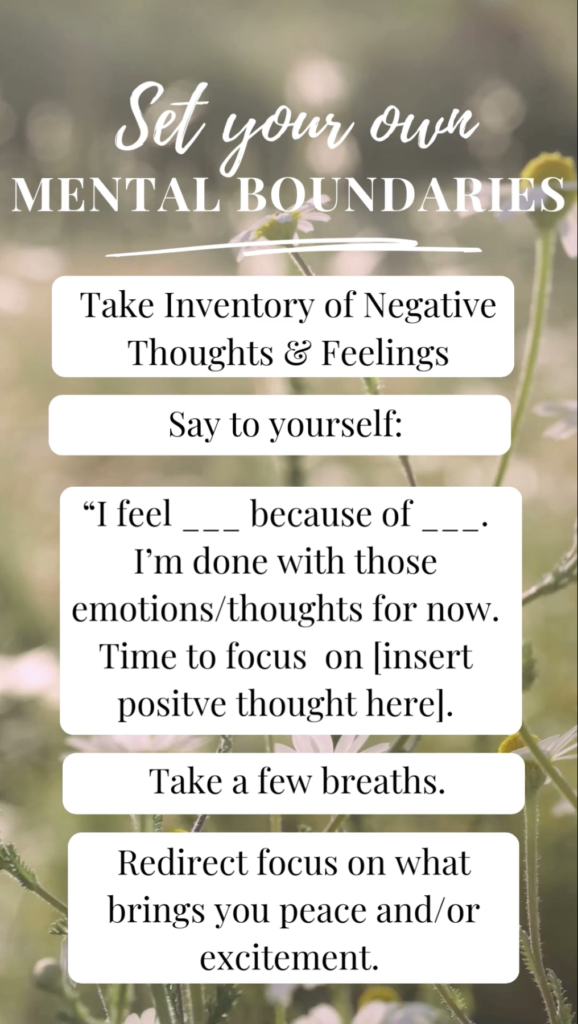
Skills to set your own mental boundaries

This means you take inventory of thoughts and emotions. Identify what brings you joy and what makes you feel the opposite. Usually, the not-so-good emotions are the ones you will need to set limits for. You begin to do this consciously, recognizing you have started to feel bad, angry, sad, etc. For one second or a minute at most, review the thoughts or beliefs. Acknowledge I feel X because of X. Say to yourself now I’m done with those feelings for now. Now to focus on [insert happier more positive thoughts].

Easier said than done, is what I hear most often. Truth is, it’ll feel hard and ineffective at times, depending on how strongly you feel. The trick is repetition and consistency. Once you have created a habit of doing this it will become easier and eventually automatic.

This does not mean you just ignore everything; this simply means, for the purpose of my day, I will not become consumed or taken down by these negative thoughts/beliefs. I always encourage to allow time to process the day by journaling, talking to ourselves, or allowing for emotions to come up when it feels safe to do so. For example, you can do these things if you have time in the morning and then add some minutes to your routine. Sometimes its easier at the end of the day after you have winded down and can have some time alone with your thoughts. You decide when is best for you.

Here is an example, if I’m stressing about a work presentation and it keeps popping up in my mind. I think of all the things that could go wrong, what my boss will think, will I start stuttering, what if I forget, etc. There is absolutely no need for me to think about any of these things for more than a few seconds. It’s miserable, emotionally draining, and unproductive. The best thing is to recognize what direction I am going in and notice it and choose a completely different area of focus or be proactive and spend more time preparing and practicing to increase confidence and trust that I will do great because I’m prepared.

We have choices about how we choose to think and where we put our attention.  Imagine you’ve been driving on one road, and you’ve reached a fork in the road. The road you have always traveled may be the path you frequently take where you often lose your patience. You could continue to keep going the way you have always gone or consider the new road that leads to the desired destination, offering a potentially easier path. This is where you might say, “I usually lose my temper when I’ve lost my patience. The new road gives me a 10-minute delay that allows me to calm down and I don’t end up blowing up.” You will feel better because you did not have to lose your temper. Remember, you always have a choice about how you will react or feel. The new path is another opportunity to experience something differently and determine if it’s right for you. Practice is everything. We are human, and by nature, we are designed to have intense emotions, but we don’t have to let our difficult emotions get the best of us. Intense emotions can be moved through quickly.

The path to peace is often encountered when we can effectively manage our mood, thoughts, and reactions. The mental and emotional boundaries we set can lead us to more moments of peace, happiness, and more of what we do want in our lives. Boundaries within ourselves is part of the path of self-mastery and truly healing.

Redefining Self-Care for a Meaningful Life

There’s a big misconception about what self-care is. The truth is that getting a facial or painting your nails is the furthest form of self-care. Although there is nothing wrong with taking care of yourself by having pretty nails or great skin… it really is skin-deep. We can’t nurture and care for our minds, our human spirit, and the core of our being by treating only the surface.

The truest form of self-care is genuinely taking care of your deepest needs. We must look profoundly within ourselves to identify and manage what no longer serves us. To let go of the thoughts, habits, and choices that keep us down. Take a moment and determine for yourself if redefining self-care in your life would be wise.

Here are five ways to redefine self-care:

  1. Learning how to be fully relaxed. Life these days is very busy, rushed, and at times chaotic. There’s so much to do and so little time. Being so busy can lead to physical tension that becomes physically disruptive. So many people suffer from headaches, shoulder and neck tension, tightening of the jaw, wringing of the hands, jitteriness, anxiety, etc. We live in a society where real relaxation is hard to access. When was the last you felt mentally, emotionally, and physically relaxed? Some might say the last time they went on vacation. The issue with that is we need to be able to relax nearby or at home. The quickest way is to change your environment and enjoy the warm sun, cold breeze, or the shade under a tree.  Other ways to relax might include taking a bath, enjoying your hammock, meditating, hiking to enjoy the view, or watching the waves reflect the sunset. Our environment is a quick way to tap into moments of peace for relaxation. The goal of accessing relaxation is to manage your thoughts and naturally ease into peace. We start with taking a few minutes to relax and make this a daily practice.

  2. Learning to pause is a powerful skill. Naturally, we are wired to feel the urge to accomplish tasks or meet deadlines. Many are under pressure because of work, school, bills, children, etc. We have become a society of go-go-go. People have become so overwhelmed and frazzled. A moment of pause, which could be minutes to hours, is meant for you to reset your nervous system. To reassess how you are going about doing something. If you are overwhelmed because you are running late, your mood changes, you rush, and then, before you know it, you trip and fall. For others, it might be that you won’t meet a deadline, and rushing is causing you to make more mistakes. Briefly gather your thoughts, give yourself a pep talk, regulate your breath, and return to what you need to do. Someone once said people take life too seriously, making simple moments complicated. Taking a moment to pause is a reminder to keep it simple.
  3. Take the time to process emotions. Create enough awareness to know how you are feeling throughout the day. Let me explain what this would look like: you’re driving, and someone cuts in front of you, causing you to slam on your breaks. You’ve become startled or angry, and now you are visibly and physically upset. This would be the perfect time to talk to yourself and label your feelings. Is it worth the reaction it creates? After a few moments of exploring, be mindful and acknowledge that the moment has passed. You are okay, and you will continue to drive safely. We must remember that we experience many emotions in one day and sometimes in one minute. We constantly feel, and most of the time, we don’t acknowledge how we feel. Unprocessed emotions accumulate. Emotions are meant to be felt and expressed. At the end of the day, take 5-10 minutes to reflect on the emotions felt, thoughts, or moments that stand out to you.
  4. Setting boundaries within yourself. Think about how rampant the mind can be when too much is happening. Thoughts are going a million miles a minute. If one is not intentional, there are no limits or guardrails to keep thoughts and emotions under control. By nature, most people experience some level of anxiety, which can range from mild worry to physical extremes such as panic attacks. Thoughts may spiral out of control. This is why setting mental boundaries within yourself is essential. Mental limits must be created to manage and limit the time spent on emotionally draining or challenging thoughts. The first step is to learn to interrupt unhealthy thoughts by becoming self-aware and choosing to distract yourself. Distraction is the early method of intervention. Ideally, distract yourself with something brief enough to stop unwanted thoughts and then return to what you must do.
  5. The ultimate act of self-care is self-love. To love yourself unconditionally, imperfect yet perfect. To love ourselves, we will nurture healthy choices and thoughts. Even on a bad day, we can take a moment and appreciate the endurance, tolerance, and strength needed to accomplish all we do. Self-care is saying no when something does not align with you—choosing yes when the whisper of your intuition keeps saying yes. Self-care is learning to set boundaries within and then ultimately with others. Learning to love ourselves one step at a time would be a great benefit. Sometimes it starts on the outside, and sometimes it starts on the inside. The first step is to intentionally cultivate your mind, relationships, and life that aligns with you and for you. This means having compassion for yourself just as when you have compassion for others. This is kindness gone full circle.

These are not your typical self-care practices, but they are very much at the core of what it is to express caring for yourself. Most people want to be the best version of themselves, and knowing how to begin can be confusing when half of the information on the internet suggests getting a pedicure, a massage, cleaning, or listening to a podcast as a catalyst of change. Yes, physical self-care is essential in many ways, but it is limiting to profound and meaningful change that can positively change your life for the long haul.

Related Posts

Purposely Peaceful Core Values

A guide to living with purpose, peace, and authenticity.  Here are but a few examples. What are your top 3? 1. Inner Peace First – Prioritizing mental, emotional, and spiritual calm in all aspects of life.  2. Authenticity – Embracing your true self without fear of judgment.  3. Empowerment – Providing tools, guidance, and support READ MORE

Read More

Join Our Newsletter