Core Beliefs Are Quietly Running the Show (And What You Can Do About It)

Let’s talk about something that’s silently—but powerfully—shaping your life:
Core beliefs.

These deeply rooted thoughts are running in the background, influencing how you think, feel, respond, and make decisions… and most of the time, we don’t even realize they’re there.

But here’s the truth:
If you’re someone seeking real, lasting inner peace, understanding your core beliefs isn’t just helpful—it’s essential.


What Are Core Beliefs, Really?

Core beliefs are the ideas we hold about ourselves, others, and the world. They shape how we interpret everything—from a stranger’s comment to the way we talk to ourselves in the mirror.

These beliefs are like a lens we see the world through. They’re subtle but strong. They’re constantly coloring our expectations, reactions, and sense of identity.

And most of them? We didn’t choose consciously.


So, Where Do They Come From?

Core beliefs often begin in childhood. We absorb them from the environment around us—without anyone needing to say a word.

Think about your parents or caregivers. Were they critical? Fearful? Confident? Anxious? Loving?
You likely absorbed some of that energy, even if it wasn’t ever talked about.

For example, my mom and some of my aunts were always a little anxious. I have so many memories of them squealing or getting startled by simple things. It was like they were constantly on edge, ready to be scared. As a kid, I didn’t realize it, but I was already picking up on beliefs about fear, safety, and unpredictability.

Then we go to school, and the conditioning continues.
We learn what gets rewarded. We learn what gets us in trouble.
Shame becomes a teacher.
By middle school, we’re dressing alike, thinking alike, and shrinking ourselves to fit in. I have so many memories of doing that—shrinking for comfort, but also to make other people more comfortable.

It was in those small moments that I started becoming more self-aware… but I didn’t yet understand what I was actually carrying.


Our Minds Are Programmable (Even If That Sounds Weird)

When I was learning Quantum Healing Hypnosis Technique (QHHT), Dolores Cannon said something that really stuck with me:
Watching TV is the first stage of hypnosis.

That blew my mind—but it makes sense.

Think about it. We’ve seen ketchup, toilet paper, and soda commercials our entire lives. So when I say “ketchup,” a brand probably popped into your head without even trying.

That’s the power of suggestion.
That’s programming.

So if I walk into a store and see 50 different kinds of ketchup, I’m most likely going to reach for the one my subconscious already associates with safety or familiarity. But now, I look at ingredients. I’ve become more intentional. And that’s the point—what you’re exposed to matters.
Your brain is always absorbing, and it’s been that way since birth.


The Subconscious is a Recording Machine

Hypnosis has shown me just how powerful the subconscious really is.
I’ve witnessed people recall vivid, detailed memories—not just from this life, but from past lives—with so much clarity it’s like they’re reading from a script.

Science says we only use about 5% of our conscious mind. The other 95%? That’s the subconscious.
To me, that means your mind is capable of recording every single moment of your life.

And here’s something else I’ve learned:
The subconscious wants you to heal.

That’s why you have triggers.
That’s why life pulls you out of autopilot with unexpected challenges.
It’s not punishment—it’s an invitation.


A Personal Story: When a Belief Was Born

Let me give you an example of how core beliefs get created.

In 10th grade, I moved to a new city and started at a new school. A few months in, a girl I had become friends with said,
“When I first met you, I didn’t like you. You seemed stuck up. But now that I know you, you’re actually really cool.”

At the time, I laughed it off. But something in me held onto it.
I had heard similar things before… and a new doubt crept in:
“If people keep thinking that about me, maybe they’re right.”

That belief—that I must come off as unlikable—followed me into adulthood.
It made me second-guess first impressions.
I’d assume people didn’t like me, even if there was no real reason to believe that. I’d either overcompensate to prove I was likable… or shut down completely.

And even now, after years of inner work, that belief still shows up sometimes.
But the difference is: I have tools now.

Here’s what I remind myself:

  • I mean well.

  • I never intentionally try to be rude.

  • I’m allowed to feel peaceful without having to prove it.

  • How others perceive me is not my responsibility.

  • I sincerely wish people well.

That’s my truth.
So when old beliefs try to take the wheel, I come back to that.


Can More Than One Belief Exist at the Same Time?

Yes. And that’s what makes this so complex.

In that same situation, I also believed I’m kind, thoughtful, and want to connect with people.
So while part of me feared being disliked… another part of me just wanted to be real and connect.

Both were true.
The question is: Which one gets to lead?
My truth—or my fear?

That’s a personal choice.


Do Core Beliefs Come from Past Lives?

Yes—I believe they can.

Through hypnosis, I’ve seen again and again that not all core beliefs were formed in this lifetime. Some stretch back to past lives, ancestral trauma, or energetic imprints we’re still carrying.

I’ve worked with people who have intense feelings of low self-worth… but nothing in their current life explains it. Their childhood was supportive. Their relationships were fine. But those feelings were still there—like they were born with them.

Through hypnosis, we’ve uncovered that these beliefs began in lives long before this one.
And that awareness brings freedom.

Just because a thought or belief shows up… doesn’t mean it’s true.
Sometimes, it’s just a whisper from your past, asking to be healed.


How Core Beliefs Affect Our Daily Lives

Let’s take a common example: the people pleaser.

They say yes when they mean no.
They overextend themselves to avoid conflict or rejection.
They confuse love with sacrifice.

That’s a belief at work.
It might sound like: “I’m only valuable when I’m useful,” or “If I say no, they’ll leave.”

I see this all the time in my work.

But here’s the truth:
Loving yourself means understanding how you feel, and making decisions from that place.
And if you don’t know your beliefs…
You can’t reclaim your peace.


So, How Do We Start to Shift Core Beliefs?

Start here:
“What is the most loving thing I can believe—or do—in this moment?”

Let that question guide you.

Because your beliefs shape:

  • What you believe is possible

  • How fair or unfair life feels

  • Who’s right or wrong

  • And what kind of peace you allow yourself to experience

Beliefs aren’t inherently good or bad—they’re just powerful.
And if they’re misaligned with your truth, they will create tension.

The work is simple, but deep:
✨ Get curious
✨ Get honest
✨ Then get intentional


Final Thoughts

Core beliefs shape your identity, your peace, and your potential.
And when you become aware of them, you get to choose.

Does this belief support the life I’m creating? Or is it time to shift it?

Ask yourself these questions.
See what comes up.
And stay tuned for Part 2, where I’ll go deeper into how to identify and rewire your core beliefs—so they actually support your intention to live a Purposely Peaceful life.

If you ever want to see more of my day-to-day real life as I walk this journey of becoming purposely peaceful, follow me @jess_riverak.

And if you’re into podcasts, you can listen to Purposely Peaceful wherever you tune in. It’s honest, soulful, and straight from the heart:
Listen on Apple Podcasts
Listen on Spotify

Feel to Heal: The Emotional Work You Can’t Skip

Let’s talk about emotions — not the fluffy, surface-level kind that pop up and fade away. I mean the deep, lingering ones. The kind that stick around, press on your chest, or sneak into your thoughts at 2AM. The emotions you’ve been holding onto without even realizing it.

We all have them. And here’s the truth: you can’t heal what you won’t feel.

The Emotional Backpack We All Carry

Picture this — you’re walking through life with an invisible backpack. And every time you experience something painful, stressful, or overwhelming and don’t process it… it goes into the backpack.

A harsh word someone said? Pebble.

A betrayal that shattered your trust? Rock.

A trauma that changed you? Boulder.

Over time, this backpack gets heavier. And because we’re busy — working, parenting, caregiving, surviving — we rarely stop to unpack it. But our bodies feel the weight even when our minds are too distracted to notice.

Eventually, it catches up. Sometimes it looks like burnout. Sometimes it shows up as anxiety, panic, or chronic exhaustion. Other times, the body literally shuts down — because it’s been screaming for rest and release.

I’ve lived this. I’ve worked through this. And I’ve walked countless clients through the same realization: your emotions are trying to tell you something. Are you listening?

What We Were Never Taught

Most of us were never taught how to feel. We learned how to suppress. How to perform. How to keep going no matter what.

“Stop crying.”
“Suck it up.”
“Don’t be so sensitive.”

Sound familiar?

So, we learned to disconnect from our emotions instead of understanding them. But here’s the thing — emotions aren’t the enemy. They’re messengers. They’re trying to help you heal.

The Four-Part Cycle of Emotional Healing

If you’re ready to lighten your emotional load, start here:

1. Feel

Emotions are meant to be felt. That’s their job — to signal something inside us that needs attention. Whether it’s sadness, anger, fear, or even joy, allow yourself to feel it fully, without judgment.

2. Acknowledge

Bring awareness to what’s coming up. Name it. Is it grief? Is it shame? Is it resentment? When you name it, you reclaim some of your power over it.

3. Process

This is where healing happens. Journaling, therapy, meditation, or simply sitting in stillness — whatever helps you understand why that emotion exists and what it’s asking from you.

4. Release

Let go of what no longer serves you. Not by pretending it never happened, but by deciding you don’t need to carry it anymore. This might look like breathwork, crying, visualization, prayer, or even speaking it out loud.

Healing Is a Layered Journey

Sometimes you think you’ve healed something, and then — boom — it shows up again. That doesn’t mean you’re failing. It means you’re meeting that emotion at a deeper level. With new insight. With more strength.

Be patient with yourself. Some wounds heal in layers.

You Don’t Have to Carry It All

You don’t have to be the strong one all the time. You don’t have to pretend it doesn’t hurt. You don’t have to hold onto pain just because you’ve held it for so long.

You can feel it.

You can heal it.

And you can create a life that’s lighter, softer, and more peaceful — one emotion at a time.


💛 Want to explore this more deeply?
Listen to Episode 4: “Feel to Heal on the Purposely Peaceful Podcast for a heartfelt, guided look at emotional healing here.

If you’d like to stay connected or see a bit more of my day-to-day, you can find me on Instagram @jess_riverak. I share reflections, gentle reminders, and glimpses into real life as I walk this path too.


What is Quantum Hypnosis

Let’s start off with what it’s not. Quantum Hypnosis is not what you once may have seen at the fair where people from the audience are asked to go on stage and do silly dances. This type of hypnosis is not suggestive and does not implant what you should think or do. The first program I was trained in was by Dolores Cannon, who created the Quantum Healing Hypnosis Technique (QHHT). Since then, I have trained to be a Beyond Quantum Healing (BQH) Practitioner, which was created by Candance Craw-Goldman. They are different styles of quantum hypnosis but are similar with their intent to help people heal. The purpose is indeed to help people find peace and healing by learning through yourself.

Quantum Hypnosis is relaxation with a purpose that allows your subconscious to reveal itself. Most often, the subconscious is trying to reveal something to you.  

With this method of hypnosis, the practitioner is not leading you to come up with a story. As practitioners, we simply ask you to share what you are feeling, seeing, hearing, and experiencing. Your mind will create an image or feelings, and we ask questions to help you understand what you are experiencing. Essentially, you are helping paint the picture for us to walk this journey with you and help you explore what your subconscious has brought up. We help you help yourself on your healing journey.

There are three parts to Quantum Hypnosis:

Interview: This is the first part of the session. Here, the Practitioner discovers the reasons behind the individual’s participation in a hypnosis session. The interview is also a short review about your life, relationships, goals, etc. This process is usually 1.5-2 hours long.

Past Lives, Guides, and Memories:

The last two hours of the visit are under hypnosis, where the subconscious will bring up what it wants you to see. This can range from early memories that may need revisiting to a past life. In a past life, it’s you in a different body and in a different environment. Usually, there is something for you to see and experience. The practitioner aims to help you understand why you are having this experience. For some it may be a visit from a loved one or guides of some sort.

Subconscious:

If possible we access the deepest part of your subconscious. We can ask direct questions to the part of you that holds all the answers, which is what Dolores Cannon called the higher Self, the Over-Soul, or the Super Conscious. This is where questions that you are seeking answers to can be answered. Questions can range from why I have leg pain to why I attract certain kinds of relationships. Questions can be about health, life struggles, finances, relationships, and pretty much anything about yourself and your experience in this life.

This is but a brief explanation of what Quantum Hypnosis does. The stories from sessions are absolutely incredible, profound, and life-changing. This is something I highly recommend people experience at least once in their lives if they are feeling called.  Please feel free to ask any questions if you are wondering if hypnosis is best for you!

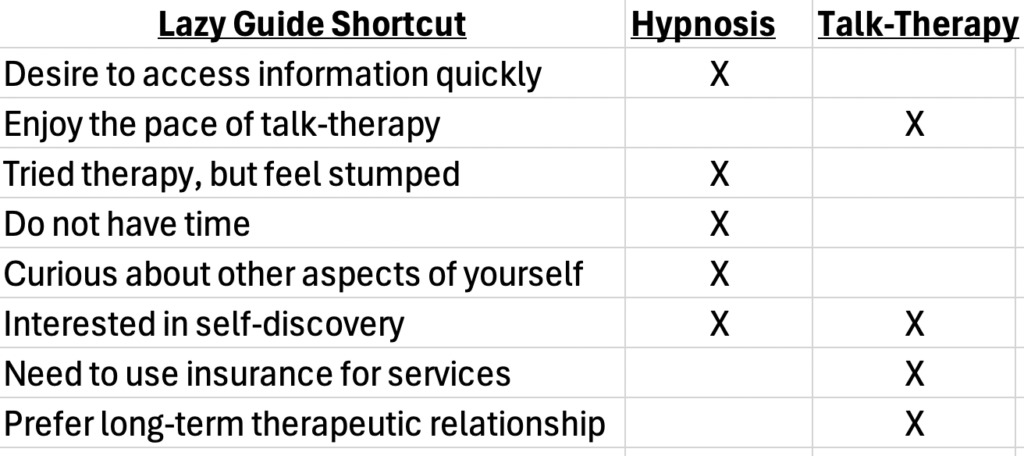
The Lazy Person’s Guide to Inner Peace (Hint: It’s Quantum Hypnosis)

For starters, let’s be honest: Most people seeking inner peace are anything but lazy. They are usually on a journey that is often many layers deep and lifelong. In this guide, we will discuss what may actually be considered lazy.

If you are in the process of becoming the best version of yourself, then I might just have the answer for you. As a marriage and family therapist for over a decade and a half, I have witnessed people’s commitment to improving themselves. For some, a few months of weekly sessions are enough, but others have committed years to steady progress. This is great, but what if you don’t want to put in years or several months of therapy?

As a therapist and quantum hypnosis practitioner, I have noticed clients are looking to do the same thing through two different methods. Both methods look at conscious and subconscious beliefs, motivations, and meanings. The difference is how information is accessed. Therapy is slower, takes time, and processes. Hypnosis has the potential to get you straight to the answers in one session. That’s right, a few hours of your time, and you may understand what your subconscious has been trying to tell you all along. Disclaimer, every hypnosis session is different and unique. Some may get more information and clarity than others, but I have yet to have someone not experience anything. Every person has some kind of unique experience.

The limitation of the hypnosis session is that after you have gained valuable insight, you are free to return to life as usual, but without continued support. After every session, you should receive the audio recording of your session. Once you receive the recording it is recommended that you listen to the audio at least three times to integrate what you have heard fully. Many people thrive sufficiently without support afterward, but let’s challenge this.

As someone who has helped people, I too have been helped in many ways throughout my life. Sometimes I had to ask for help and sometimes others knew I needed help when I could not see it for myself. Being in therapy and in hypnosis are simply different means of access, but both are to create positive change and healing. Ultimately, we are seeking inner peace. We cannot always walk this path alone. We are complex and unique, and we all get stuck at times. Support is to help move you through what has become challenging. Sometimes we do not realize or notice our own patterns and contradictions. Continued support from someone trained to do it could make a world of difference on your journey.

If you self-identify as a somewhat lazy person and you need guidance on your path to inner peace, I highly recommend quantum hypnosis. It’s a quick jolt into what you may need to work on or find peace or closure. If you like the momentum, I offer continued support after a hypnosis session. There is tremendous value both in your investment to heal and your commitment to becoming the best version of yourself. There are many paths to take on this journey, and I recommend you lean into your intuition for guidance on what is best for you.