
The Lazy Person’s Guide to Inner Peace (Hint: It’s Quantum Hypnosis)

For starters, let’s be honest: Most people seeking inner peace are anything but lazy. They are usually on a journey that is often many layers deep and lifelong. In this guide, we will discuss what may actually be considered lazy.

If you are in the process of becoming the best version of yourself, then I might just have the answer for you. As a marriage and family therapist for over a decade and a half, I have witnessed people’s commitment to improving themselves. For some, a few months of weekly sessions are enough, but others have committed years to steady progress. This is great, but what if you don’t want to put in years or several months of therapy?
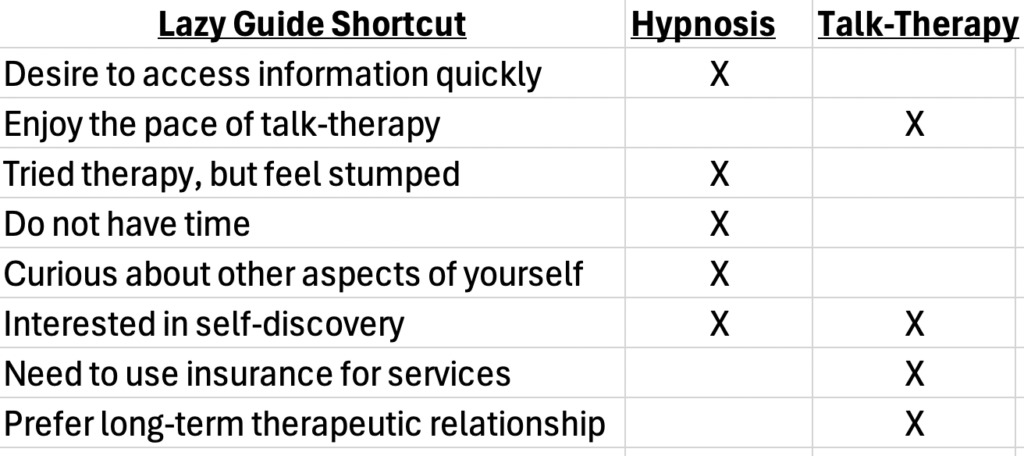
As a therapist and quantum hypnosis practitioner, I have noticed clients are looking to do the same thing through two different methods. Both methods look at conscious and subconscious beliefs, motivations, and meanings. The difference is how information is accessed. Therapy is slower, takes time, and processes. Hypnosis has the potential to get you straight to the answers in one session. That’s right, a few hours of your time, and you may understand what your subconscious has been trying to tell you all along. Disclaimer, every hypnosis session is different and unique. Some may get more information and clarity than others, but I have yet to have someone not experience anything. Every person has some kind of unique experience.

The limitation of the hypnosis session is that after you have gained valuable insight, you are free to return to life as usual, but without continued support. After every session, you should receive the audio recording of your session. Once you receive the recording it is recommended that you listen to the audio at least three times to integrate what you have heard fully. Many people thrive sufficiently without support afterward, but let’s challenge this.

As someone who has helped people, I too have been helped in many ways throughout my life. Sometimes I had to ask for help and sometimes others knew I needed help when I could not see it for myself. Being in therapy and in hypnosis are simply different means of access, but both are to create positive change and healing. Ultimately, we are seeking inner peace. We cannot always walk this path alone. We are complex and unique, and we all get stuck at times. Support is to help move you through what has become challenging. Sometimes we do not realize or notice our own patterns and contradictions. Continued support from someone trained to do it could make a world of difference on your journey.

If you self-identify as a somewhat lazy person and you need guidance on your path to inner peace, I highly recommend quantum hypnosis. It’s a quick jolt into what you may need to work on or find peace or closure. If you like the momentum, I offer continued support after a hypnosis session. There is tremendous value both in your investment to heal and your commitment to becoming the best version of yourself. There are many paths to take on this journey, and I recommend you lean into your intuition for guidance on what is best for you.
Redefining Self-Care for a Meaningful Life

There’s a big misconception about what self-care is. The truth is that getting a facial or painting your nails is the furthest form of self-care. Although there is nothing wrong with taking care of yourself by having pretty nails or great skin… it really is skin-deep. We can’t nurture and care for our minds, our human spirit, and the core of our being by treating only the surface.

The truest form of self-care is genuinely taking care of your deepest needs. We must look profoundly within ourselves to identify and manage what no longer serves us. To let go of the thoughts, habits, and choices that keep us down. Take a moment and determine for yourself if redefining self-care in your life would be wise.

Here are five ways to redefine self-care:

  1. Learning how to be fully relaxed. Life these days is very busy, rushed, and at times chaotic. There’s so much to do and so little time. Being so busy can lead to physical tension that becomes physically disruptive. So many people suffer from headaches, shoulder and neck tension, tightening of the jaw, wringing of the hands, jitteriness, anxiety, etc. We live in a society where real relaxation is hard to access. When was the last you felt mentally, emotionally, and physically relaxed? Some might say the last time they went on vacation. The issue with that is we need to be able to relax nearby or at home. The quickest way is to change your environment and enjoy the warm sun, cold breeze, or the shade under a tree.  Other ways to relax might include taking a bath, enjoying your hammock, meditating, hiking to enjoy the view, or watching the waves reflect the sunset. Our environment is a quick way to tap into moments of peace for relaxation. The goal of accessing relaxation is to manage your thoughts and naturally ease into peace. We start with taking a few minutes to relax and make this a daily practice.

  2. Learning to pause is a powerful skill. Naturally, we are wired to feel the urge to accomplish tasks or meet deadlines. Many are under pressure because of work, school, bills, children, etc. We have become a society of go-go-go. People have become so overwhelmed and frazzled. A moment of pause, which could be minutes to hours, is meant for you to reset your nervous system. To reassess how you are going about doing something. If you are overwhelmed because you are running late, your mood changes, you rush, and then, before you know it, you trip and fall. For others, it might be that you won’t meet a deadline, and rushing is causing you to make more mistakes. Briefly gather your thoughts, give yourself a pep talk, regulate your breath, and return to what you need to do. Someone once said people take life too seriously, making simple moments complicated. Taking a moment to pause is a reminder to keep it simple.
  3. Take the time to process emotions. Create enough awareness to know how you are feeling throughout the day. Let me explain what this would look like: you’re driving, and someone cuts in front of you, causing you to slam on your breaks. You’ve become startled or angry, and now you are visibly and physically upset. This would be the perfect time to talk to yourself and label your feelings. Is it worth the reaction it creates? After a few moments of exploring, be mindful and acknowledge that the moment has passed. You are okay, and you will continue to drive safely. We must remember that we experience many emotions in one day and sometimes in one minute. We constantly feel, and most of the time, we don’t acknowledge how we feel. Unprocessed emotions accumulate. Emotions are meant to be felt and expressed. At the end of the day, take 5-10 minutes to reflect on the emotions felt, thoughts, or moments that stand out to you.
  4. Setting boundaries within yourself. Think about how rampant the mind can be when too much is happening. Thoughts are going a million miles a minute. If one is not intentional, there are no limits or guardrails to keep thoughts and emotions under control. By nature, most people experience some level of anxiety, which can range from mild worry to physical extremes such as panic attacks. Thoughts may spiral out of control. This is why setting mental boundaries within yourself is essential. Mental limits must be created to manage and limit the time spent on emotionally draining or challenging thoughts. The first step is to learn to interrupt unhealthy thoughts by becoming self-aware and choosing to distract yourself. Distraction is the early method of intervention. Ideally, distract yourself with something brief enough to stop unwanted thoughts and then return to what you must do.
  5. The ultimate act of self-care is self-love. To love yourself unconditionally, imperfect yet perfect. To love ourselves, we will nurture healthy choices and thoughts. Even on a bad day, we can take a moment and appreciate the endurance, tolerance, and strength needed to accomplish all we do. Self-care is saying no when something does not align with you—choosing yes when the whisper of your intuition keeps saying yes. Self-care is learning to set boundaries within and then ultimately with others. Learning to love ourselves one step at a time would be a great benefit. Sometimes it starts on the outside, and sometimes it starts on the inside. The first step is to intentionally cultivate your mind, relationships, and life that aligns with you and for you. This means having compassion for yourself just as when you have compassion for others. This is kindness gone full circle.

These are not your typical self-care practices, but they are very much at the core of what it is to express caring for yourself. Most people want to be the best version of themselves, and knowing how to begin can be confusing when half of the information on the internet suggests getting a pedicure, a massage, cleaning, or listening to a podcast as a catalyst of change. Yes, physical self-care is essential in many ways, but it is limiting to profound and meaningful change that can positively change your life for the long haul.

Related Posts

Join Our Newsletter